Finally, somewhere to put your drink, everywhere it already goes.
122 reviews · 4.9 average · 98 verified purchases
Steadi Labs LLC — Scott Rodriguez, founder. Veteran founded.
3419 E Chapman Ave #411, Orange, California · hello@steadilabs.com
“First time I have ever ordered from Facebook feed. Very easy. Happy with product.”Steve Butler · 8 August 2026
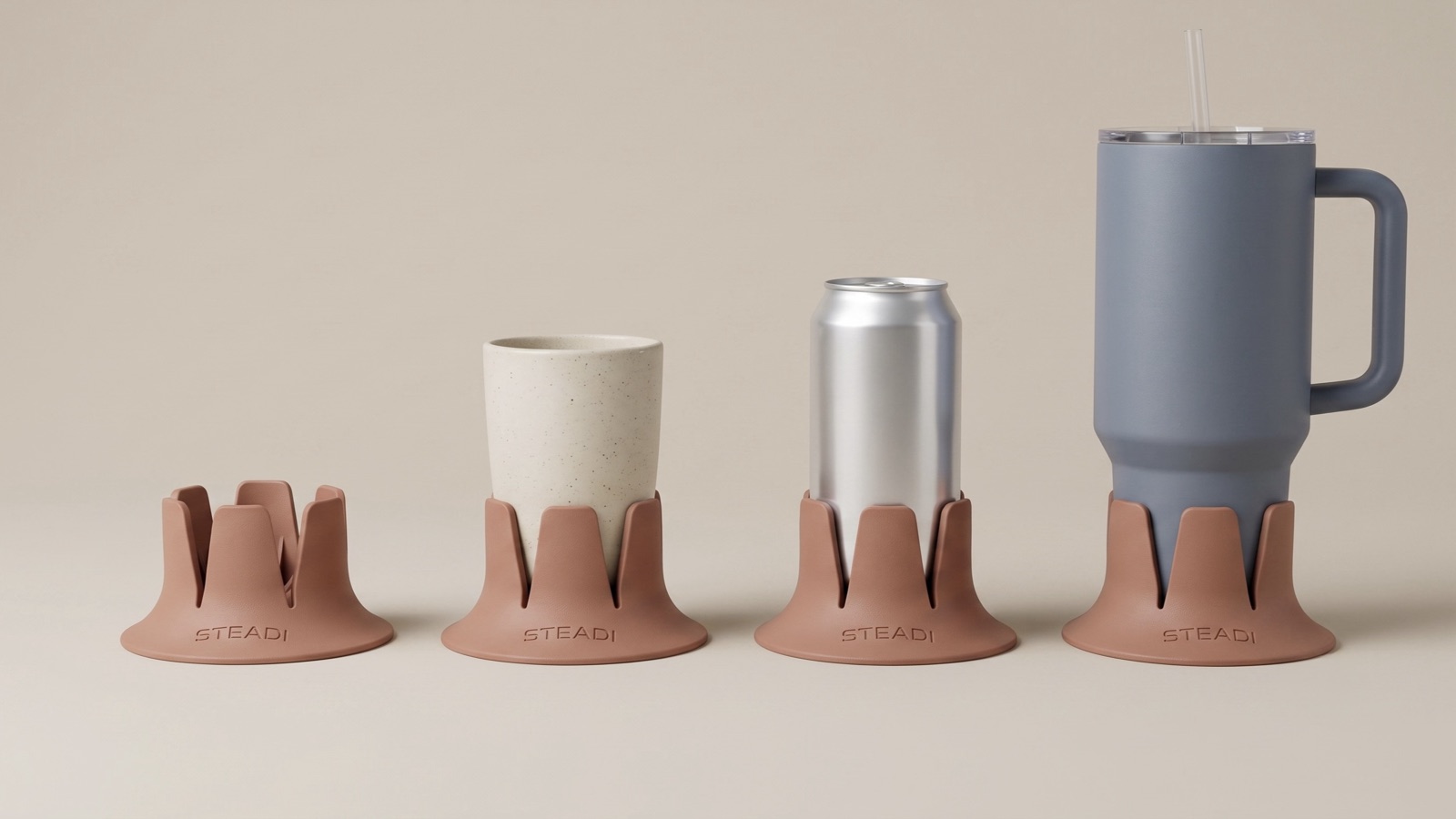
Your Stanley or Owala rides from the car to the gym to the desk and back — and almost none of those holders were actually sized for it. One flexible-finned base grips the bottom inch, wherever it lands next.
Get Yours – from $14.95Fits Stanley, Owala & Hydro Flask — 90 days to prove it, free shipping both ways.
Will the bottle that's already in your bag actually fit? A sticky note settles it ↓
It's happened to you
The same bottle, six different close calls.
The 40 oz tumbler is riding on top of the console cup holder, not seated in it — the well's too narrow for the base. Braking at the light sends it tipping straight into the passenger seat.
The bottle set down at foot level gets clipped by someone stepping past on their way to the next machine, and it rolls under the bench with water trailing behind it.
A metal bottle propped at the corner of the mat gets caught by a foot moving into the next pose and crashes to the studio floor — the clang landing in a room that had just gone silent.
The bottle in the machine's own holder has been rattling with every stride, and it's walked itself to the edge of the tray, one stumble from the belt.
A hand finds the nightstand bottle before it finds the phone — no rim to catch it, no light to see by, and it goes over onto the charger cord.
An elbow catches the bottle standing loose next to the laptop, and the keyboard is wet before anyone reacts.
Instant answer
Wherever the bottle is, a sticky note is closer than a spec sheet.
lands in here
A square sticky note: 3 inches, exactly — the same edge most cup holders never had room for.
A standard square sticky note measures exactly 3 inches on a side — a fact about the note, and it happens to land right at the outer edge of what fits.
Whichever one actually rides in the bag today — the Quencher, the wide-mouth bottle, the plain disposable — set it down on the square by its bottom, not its lid or its flip straw.
Base sits inside the square, it fits. Base hangs off any edge, it's too wide for this. A tiny footprint lost in the middle, under 2 inches, is too narrow to grip.
No spec sheet, no reverse-engineering a brand's diameter listing off a product page — one sticky note answers it with the bottle already in your hand.
Fit check
The base decides, not the holder.
The rule is one line: a base 2 to 3 inches across settles in — wider or narrower and it's fighting the holder instead of sitting in it. Every verdict below follows from that.
- Stanley Quencher H2.0, 40 oz fits
- Hydro Flask Wide Mouth, 32/40 oz too wide
- Hydro Flask Standard Mouth fits
- Nalgene Wide Mouth, 32 oz too wide
- Standard 16.9 oz bottle fits
- Bike bidon-style bottle fits
- Gym shaker bottle fits
- Coffee mug, handled handle in the way
There's a floor as well as a ceiling — under 2 inches a base sits too loose, and the widest insulated tumblers, well past 3 inches, are fighting the fins from the other direction. The one honest in-between is a mug with a handle: the base itself would fit, but the handle lands exactly where a fin needs to close.
The full fit database — Stanley, Red Bull, Yeti, and 30 more, with sourced base measurements →
The value
Three reasons it survives the route.
Holds steady wherever it lands
The wide, low base doesn't need a matching well to work with. Set the bottle down on a car console, a gym floor, a treadmill tray, or a desk, and the fins close around its bottom inch so it settles in instead of perching on a rim it was never sized for.
Sized for the bottle that's actually in your hand
A 30 to 40 oz insulated tumbler runs wider at the base than the can and the drive-through cup this whole category was originally built around. The fins flex open to meet it — the Stanley, the standard-mouth Hydro Flask, the disposable bottle in the door pocket — instead of asking the bottle to shrink.
Travels with the bottle, not the room
It isn't bolted to a desk or clipped to a machine. It moves in a bag pocket from the car to the gym to the nightstand, so the grip that worked at 7 AM is still there at 9 PM, wherever the bottle ends up next.
Function
Built for a holder that never matches.
Factory wells and cardio-machine rings were sized to a can or a generic cup, not a bottle running 3 inches or wider at the base. This sits across the opening instead of trying to wedge inside it, so the bottle needs a base to stand on, not a well shaped to match it.
Flexible fins grip whatever base actually shows up — a narrower disposable bottle or a wide insulated tumbler — by the bottom inch, so the drink can't rattle loose over a treadmill's stride or slide across a bumped desk.
A knee under the desk, a foot near the mat, hard braking at a light — the low, wide base rocks with the bump and brings the bottle back level instead of letting a tip get started.
From the reviews
What buyers say.
Real reviews of the Steadi — these ones mention water life.
I have a tendency to spill my drinks and have two cats. This is one of the best things I’ve ever impulse bought. It works. It actually works. It’s a heavy, wide enough base that it is actually stable. My “spot” in the living room is near a somewhat-cushioned fabric ottoman, which is where I usually put my drinks. It’s
Dixie · 2026-08-30I never knock over my water at night anymore!
Steadi customer · 2026-08-21I love my Steadi can holder. I use an ottoman beside my couch for drinks and remotes. This keeps a can steady and allows me to have a can of soda or water nearby. Im disabled and its hard to get up repeatedly for a drink!
Kathi D. · 2026-08-20Really does keep your drink cans and bottles from tipping over! We are quite impressed with these!
SPK · 2026-07-25This is a great product. Does exactly as it is advertised. No more turned over water containers due to my nosey cats. My granddaughter can reach it but she can't tip it over. 😁😁
Debra W. · 2026-07-18Love my Steadi holders! I purchased two but plan to purchase more to give as gifts. Great customer service answering my questions and fast shipping.Where have these been all my life? No more spills on the sofa, trying to balance a drink or a bottle against the pillows. 100% satisfied customer. Great invention.
Catherine B. · 2026-06-1998 of the 122 published reviews are for the drink base itself. The other 24 are about ordering, shipping and customer service.
Why more than one
Two identical Quenchers. One question.
Half the gym owns the same three Stanley colorways this year, so a locker shelf ends up with two identical tumblers standing side by side with zero way to tell them apart at a glance. A base in a color she actually picked works like a nameplate that isn't a name — grab the sage one, it's hers.
Build your set
Give everyone their own.
Pick a pack, then give each one a color — so nobody has to ask which drink is theirs.
Fair questions
You're probably thinking…
No polished studio spin here — it's real footage across the car, the gym, the treadmill, and the desk, and the only claims made are what it actually does: it resists tipping and settles in, never 'spill-proof.' It's molded by a named small maker, Steadi Labs in Orange, California, not an anonymous storefront.
The 40 oz Stanley fits, confirmed. Fit runs on the base — about 2 to 3 inches across — not the ounce count on the label, so the fastest way to know for sure is the sticky-note test: a standard sticky note is 3 inches square, stand your bottle on it base-down, and if the base sits inside the square, it fits.
Colors are named for the shelf it's sitting on, not a hardware aisle — Trailhead, Poolside, Basecamp — and shot next to a real Stanley or Owala in daylight, never a white studio sweep.
Cheap expanders and silicone sleeves are built for one well, not a bottle — reviewers report they still tip under hard braking unless the well's already deep, and the soft silicone versions aren't rigid enough to carry a full 40 oz. This grips the bottle's actual base instead of the well around it, so it holds steady wherever the bottle lands next, not just the one spot an expander was shaped for.
It's molded in Orange, California by Steadi Labs, a named maker, not an anonymous storefront — backed by a real 90-day guarantee and reviews from people who actually got theirs. Checkout itself happens on steadilabs.com, the company that makes it.
Before you buy
Asked between stops, answered here.
Will my bottle actually fit?
Measure the base, not the lid or the flip straw. A base 2 to 3 inches across settles in — the 40 oz Stanley fits. Under 2 inches it's too loose to grip, and the widest insulated tumblers, well past 3 inches, are too wide for the fins to close around.
My cup holder is small and my bottle's huge — will it help in the car?
That's the exact mismatch this is built for. Factory wells were molded around a 12 oz can, commonly 2.5 to 3 inches across, while today's insulated tumblers run wider. It sits across the console's opening instead of forcing the bottle into a well that's too small, and the base and fins do the gripping the well can't.
What about a really wide bottle, like a wide-mouth Hydro Flask or Nalgene?
Those run wider at the base than what settles in here — some past 3.5 inches. The rule holds a floor and a ceiling both: 2 to 3 inches across is the range, so a standard-mouth bottle fits and the widest wide-mouth sizes are honestly past it.
Does it work on hard floors — the gym, a treadmill tray, a desk?
Yes, at least as well as anywhere else. The wide base and the fins don't need softness to grip; they hold steady on concrete, gym tile, a treadmill's molded tray, or a hard desk the same way they do on a car console.
Will it stop the bottle from walking off the treadmill?
That's the specific failure this addresses. A machine's built-in ring is sized to a generic cup, and the running vibration is constant enough to walk a loose-fitting bottle toward the tray's edge over a run. This grips the base directly instead of just cradling it, so it holds steady through a run's worth of stride instead of migrating toward the edge.
Is it a good idea near my laptop?
That's the point of using it there. A wide base and gripping fins make a bottle less likely to go over when an elbow catches it reaching for a notebook or a charger — it resists tipping. It isn't a lid, though, so pair it with a sealed bottle if the keyboard is close enough to worry about.
Does it clamp onto anything — a bike, a machine, the car?
No. Nothing bolts to a frame, clips to a machine, or tucks under anything. It sits on top of whatever surface is there — car console, gym floor, treadmill tray, desk — and travels with the bottle instead of staying behind.
How do I clean it?
Rinse it or wipe it down — whichever it's due for. It's one piece of flexible material with nothing to take apart, so gym sweat, car dust, and nightstand grime all come off the same way. the dishwasher is fine;
Who makes it, and where do I buy one?
It's called the Steadi, injection molded in small runs by Steadi Labs in Orange, California — veteran-founded, patent pending. Every order ships free from steadilabs.com, with 90 days to change your mind.
Ninety days on every stop.
Carry it for a month — in the car, at the gym, on the desk, back on the nightstand. If it doesn't do what this page says, email hello@steadilabs.com and it gets made right. No forms, no fight.
Veteran-founded · Patent pending · Made in Orange, California
One base. Every stop on the route.
The same bottle holds steady in the car, on the gym floor, at the treadmill, on the desk, and back on the nightstand — no adapter to buy, no cage to re-thread, nothing left behind at the last stop.
Get Yours – Ships FreeCheckout is on steadilabs.com — Steadi Labs is the company that makes it, wherever the bottle ends up next.